
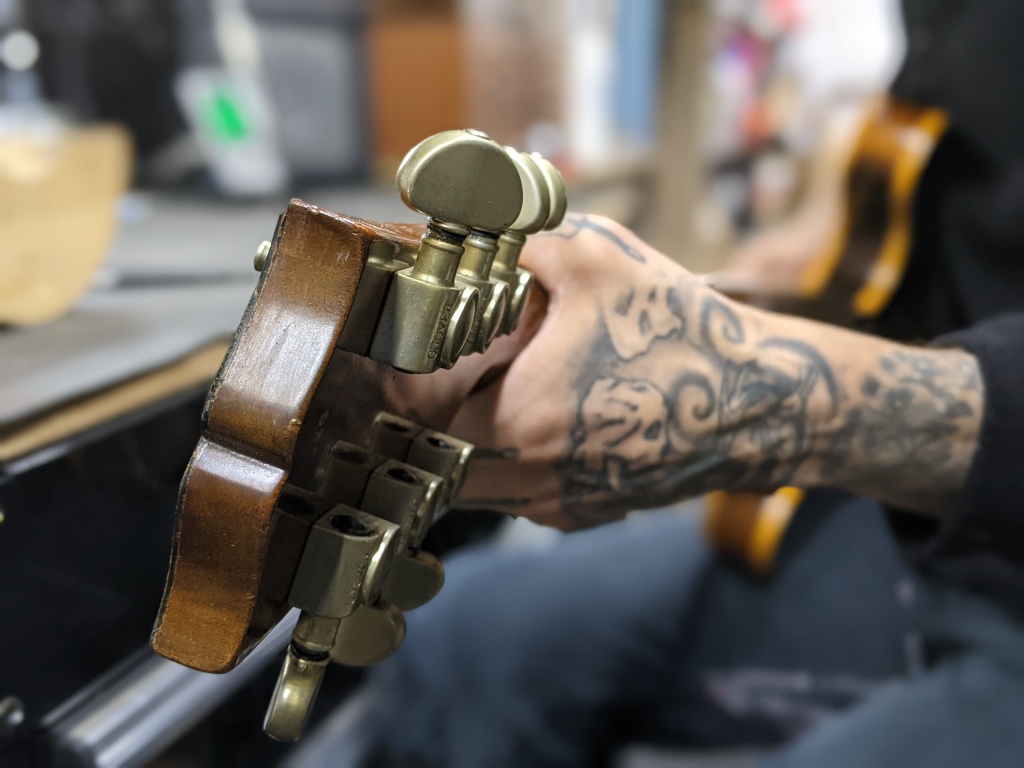
The power of suggestion will pull you in its orbit as long as you’re willing to go with it. New gear will always invoke excitement and spark some creativity that can carry you through your next session, the setlist for this weekend, or your next album. There are so many guitars and aftermarket products available today that it’s overwhelming, but it’s easy to stay grounded and figure out what you really need. Sometimes we find out that we just really want another guitar… sometimes we just need a little upgrade on our guitar to make it right.
The urge to buy a brand new guitar can be overwhelming. Clever advertising, paid reviews, and imperious dialogue to make your current axe sound inferior or obsolete. Guitar companies practically stop just short of telling you that their last year’s model doesn’t compare to the latest changes on this years model (I mean, it’s usually just a new color, right?). But what if there’s only just one issue bothering you about your current guitar?
The Power of Suggestion Series of articles is my attempt to prevent you from buying another guitar. It’s likely that there could be something you’re not aware of, or perhaps being told. Consider these options…

T u n e r s
The economy tuners on low and mid tier guitars can often be the worst thing about the guitar itself. Manufacturers reduce the cost of making each production run by cutting costs in many ways. From wood construction to the hardware and electronics installed, various parts of the guitar get downgraded as the particular model descends the tier. From one production run to the next, they might continually lower the cost by keeping the same woods and construction methods – thus not affecting the production process – and swapping out hardware during assembly. Tuners are without a doubt on the top of their cost-cutting lists. And it does make sense: tuners are probably the easiest things to swap out on a guitar. So they’ll throw a cheap set of unbranded or branded (Yes, the well-known brands have their own “economy” sets too!) tuners on the guitar and if it’s a problem for the end user; it’s their option to upgrade. As the model tier level goes up, the tuners will (or could?) get better, but often not enough for a performing musician.
Gear Ratios
14:1 is a common tuner gear ratio for guitars. This ratio means that 14 turns of the machine head equals one full revolution of the capstan, or post. The higher the ratio, the greater the ability to fine tune the string. Well made tuners with high gear ratios have very tight fitting gears that also reduce the lag you can sometimes find on mass produced tuners of equal gear ratio. A quality made 14:1 tuner will outperform an economy tuner of the same ratio. Some are so poorly made that I’ve been able to unwind a string by pulling on it from the bridge. If only the balance of precision machining and gear ratio was a focal point for most manufacturers, we wouldn’t have companies impressing us with big ratios. 18:1 is considered a high ratio for guitar but it keeps going up from there. Gear ratios for bass are much higher due to the size of the strings and generally start out in the 20:1-22:1 range.
Locking Tuners
Locking Tuners are still new to a lot of guitarists despite being on the market for 40 years now. While I have no issues with tuning stability on many of my guitars that have traditional tuners, I do have a few guitars I enjoy having them on. Guitarists who bend more notes than they pick will find solace in an upgrade to locking tuners if they struggle with tuning stability.
Perhaps the greatest pairing with locking tuners can be found in non-locking vibrato* bridges. Strats with a 6-screw or 2-post bassplate, a Starfire with a Bigsby, or your frankensteined project guitar with a Wilkinson… all perfect considerations for the upgrade. Even if traditional non-locking tuners with a high gear ratio are installed on the guitar, tuning stability can be compromised with heavy use of a vibrato system. When the strings slack from depressing the vibrato (whammy) bar, the wrapped portion of the string can slip and/or stretch. Locking tuners eliminate this wrapped portion of string that, if not stretched properly when installed, can slowly stretch out through vibrato use. Just make sure the string slots through the nut are not the true culprit!
You won’t find locking bass tuners nearly as common- or necessary- unless you’re that lead bassist with the whammy I’ve been hearing about.
Mutli-ratio Tuners
In the advent of multi-ratio, or balanced ratio tuners, I thought it might be a farce, so I got my hands on some. Each tuner has a gear ratio that is based on the diameter of the string’s core thickness. Heavier wound strings have high gear ratios ( 36:1- 48:1) while lighter plain strings are left with conventional ratios (12:1-20:1). While I don’t personally own any multi-ratio sets, I’ve installed about a dozen, mostly on acoustic and electric guitars. I was most impressed when installing them on bass guitars. Fine tuning a low B string has never been easier.
*I use the term “vibrato” because it’s accurate. Leo Fender borrowed an idea from Paul Bigsby and made a mistake in nomenclature. I’m just trying to help filter it out.
 Crown & Saddle